Parking Lots

Less expensive, more environmentally friendly, easier to maintain and long lasting... why would you even consider another pavement?
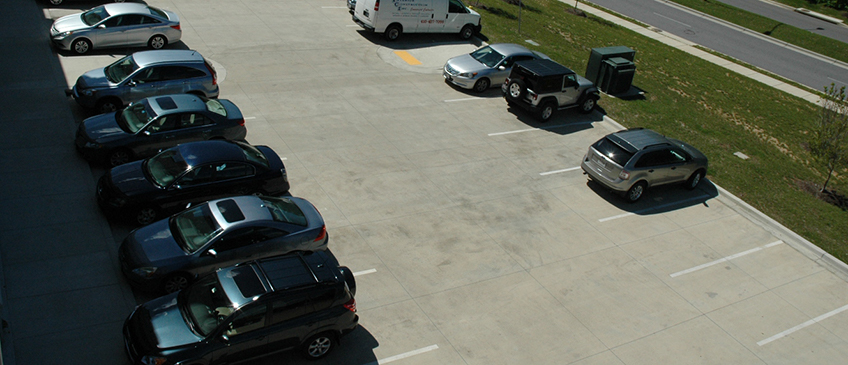
Parking Lots Photo
  1. Overview
  2. Initial Cost
  3. Life-Cycle Cost
  4. Green Parking
  5. FAQ's

Less Expensive
While concrete has always made the most sense in the long term, the rising cost of oil and enhanced refining capabilities have forced asphalt prices through the roof, making concrete the best short and long term solution for your paving needs. The durability and strength decrease installation and maintenance cost in ways you can see now and down the road. In addition, the savings on surface lighting and interior cooling because of the more reflective surface will give you benefits that will not only be green, but save you some green in the long run.

More Durable
No other paving material approaches concrete’s strength and durability in standing up to heavy usage and truck traffic. Concrete lasts longer, without the need for resurfacing, patching or surface sealing.

More Attractive
Concrete’s clean look creates a good first impression and lasting sense of quality for customers, tenants and employees. Concrete can be fashioned with an array of decorative textures, shapes, patterns and colors. 

More Green
Concrete is produced from abundant natural resources, reduces toxic run-off and can be easily recycled. It is also cooler in the summer which provides outdoor comfort while reducing the heat island effect. The reflectivity also reduces lighting energy need. On the road, concrete even improves fuel economy. 

It All Adds Up
In apples-to-apples comparisons, using ACI, AASHTO or other procedures to ensure structural design equivalents, concrete parking delivers financially, aesthetically and environmentally. 

Chaney Enterprises uses the Concrete Pavement Analyst software to put concrete and asphalt side-by-side. You can even see graphs of how the cost savings will grow over time. Set up an analysis today!

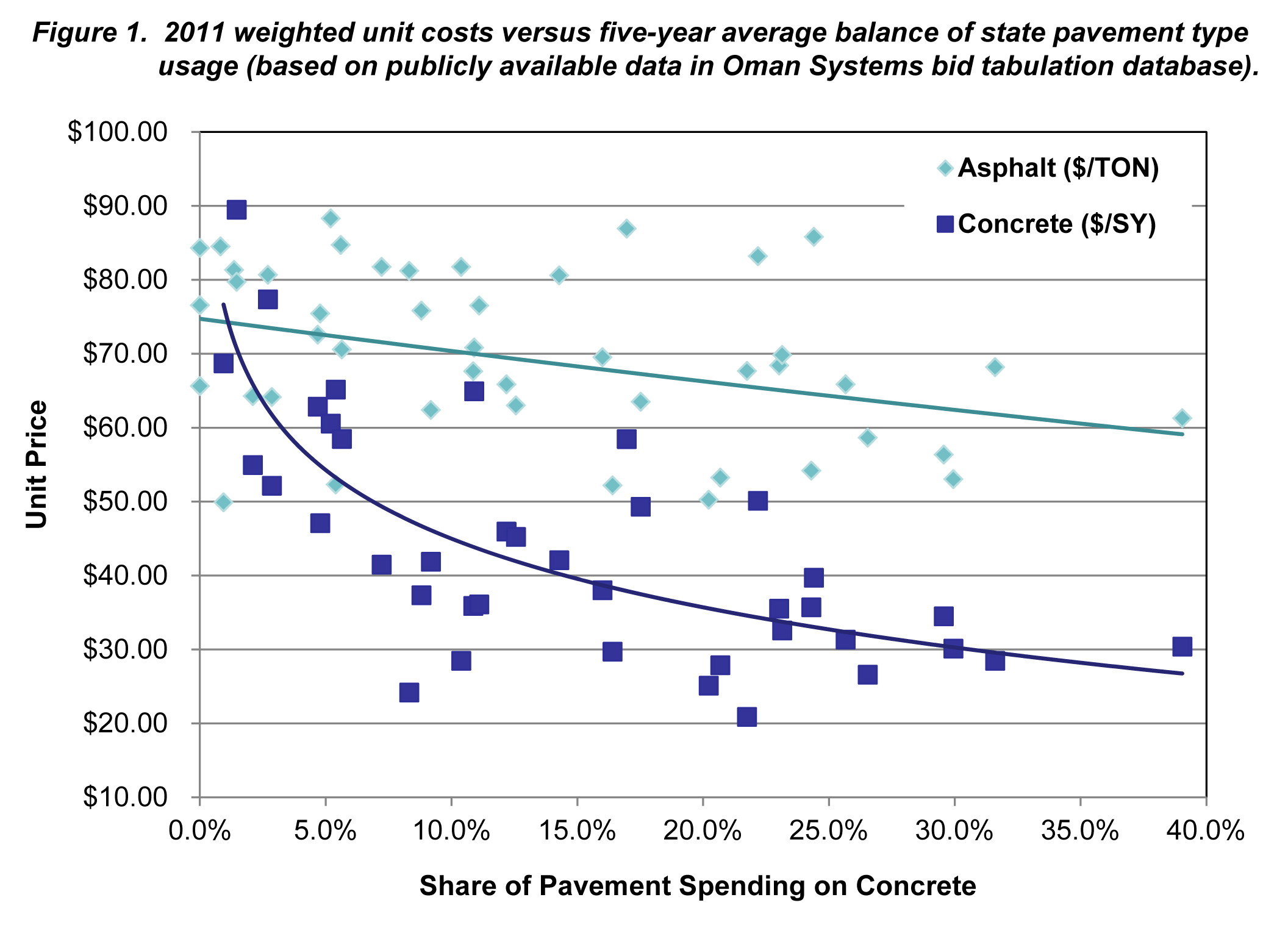
While concrete has always made the most long-term sense, advances in concrete pavement design and placement, coupled with the rising cost of liquid asphalt, have made the initial costs of concrete about the same, often beating asphalt (See Figure 1)

Compare cost of asphalt and concrete

Design Improvements

By following the latest in design from the American Concrete Institute’s ACI 330. 1-03, Specification for Unreinforced Concrete Parking Lots, engineers can save costs by having: 

No Subbase – Concrete is a rigid pavement and deflects forces outward, while asphalt is a flexible pavement which deflects forces downward (See Figure 2). An imported subbase, while necessary for asphalt, is often of little or no value for the stronger and more durable concrete (See Figure 3, Green Paving Tab). This not only saves money on the subbase but also decreases excavation costs. (ACI 330.1-03, section 3.4)
Compare design of asphalt and concrete

No wire mesh – Wire mesh provides “no useful effect on the load-carrying capacity” of concrete. A proper jointing design and execution will control cracking. (ACI 330.1-03, section 3.6.1) 

No Joint Sealing – Joints are often left unfilled with a corresponding closer joint spacing and more narrow joints. (ACI 330. 1-03, section 3.9) 

We offer ACI 330 design assistance. See the Frequently Asked Questions for more details. Because concrete parking lots are brighter and reduce lighting needs by about 30%, fewer lighting fixtures are needed, decreasing material and labor costs.

Placement Technology

Concrete paving equipment has come a long way over the years, including the advent of equipment like 3D laser screeds, which reduce crew size and increase production rates. The use of an integral curb placed at the same time as the parking lot eliminates  the need for additional subcontractors and increases efficiency.

Rising Costs of Asphalt

Asphalt costs fluctuate enormously. Typically, labor and materials are quoted separately because asphalt costs can change so quickly. Despite a recession that has cut demand for asphalt, the prices of liquid asphalt are still more than double what they were five years ago and are only expected to rise as the economy improves.

While the initial costs of asphalt and concrete are similar, there is no competition in terms of the long-term costs (See Figure 1, initial cost tab).

Less Lighting

In addition to the initial cost savings mentioned on the left page, concrete’s reflective surface decreases lighting energy up to 30%—a savings the owner can keep for the life of the project. 

Compare lighting needs of asphalt and concrete
Left: One side of this shopping center was done in concrete, the other in asphalt. Even with more installed lighting on the asphalt side, it is far darker
than the concrete side.

Less Maintenance

Increased strength and durability means less maintenance, as concrete parking lots can last decades longer. 

Less Air Conditioning

The cooler, more reflective pavement decreases ambient temperatures by about 7 to 10 degrees, which slashes peak loads during those hot summer days.

solar reflectivity of concrete versus asphaltRight: This parking lot was given a concrete overlay of the old asphalt which considerably cooled the parking lot.

When we can be green and save green too, it’s a no-brainer. Not only will concrete parking save the owner money, but concrete provides many other environmental benefits:

Recycled Content

By maximizing the use of fly ash and slag to replace Portland Cement, parking lots significantly increase the use value of the recycled content (LEED Materials and Resources Credit 4).

Strong and Durable

Concrete’s strength often means less material is needed to do the same job. Increased strength leads to increased durability. While other materials might need constant replacement, concrete can last decades longer. 

Less Raw Materials

Structural numbers to compare concrete and asphalt paving design.
Concrete’s strength usually means eliminating the need for subbase materials—and it also means you use less of it. In Figure 3, Structural Numbers are used to compare equivalent pavements, showing that 12 inches of an asphalt solution is equivalent to less than six inches of a concrete solution with the same Structural Number. 

Concrete’s Reflectivity

Concrete parking lots feel safer.Concrete’s reflectivity reduces the urban heat island effect (LEED Sustainable Sites Credit 7.1), which in turn cuts down the energy needed to light the parking area as well as cool a building on peak energy-demand days. The reflective surface also invites a safer environment, which is especially important for banks, retail and educational establishments.

Regional Materials

Concrete is made from raw materials that are often mined right here in Maryland, decreasing fuel and energy needed for transport and also feeding the local economy (LEED Materials and Resources Credit 5). Additionally, because wet concrete can only travel short distances, plants are local and support their local communities and economies. 

Recyclable

When concrete is finished with its long service life, it can be recycled. Alone, Chaney Enterprises processes more than 100 million pounds of recycled concrete each year.

Frequently Asked Questions

How can I get ACI 330 design help?
We provide an AIA-approved parking lot design class for Professional Development Hours (PDH’s). We also participate in a national Design Assistance Program (DAP) and we cover the costs of the first project within our market area. Depending on project specifics, we will offer additional DAP projects at little or no cost. All we need are the current CAD drawings and a few pieces of project information. Call 888-244-0750, ext 5885, or email
info@ChaneyEnterprises.com for more details. 

What appearance/finish options are there?
Concrete surfaces can be placed with an array of textures, shapes, patterns and colors. Virtually any style or finish you can dream of is possible. Chaney Enterprises offers an AIA class on decorative concrete to learn how to specify different options. How can I keep my surface clean? The better protected the surface, the easier it is to clean and maintain. Chaney Enterprises highly recommends the use of a quality surface sealer. 

How do I protect against freeze/thaw conditions?
ACI 330.1-03, Specification for Unreinforced Concrete Parking Lots, recommends ACI air entrainment and 4,000 psi concrete in our climate. This, coupled with quality placement per ACI 330.1-03 specifications and a quality sealer, will increase your concrete’s resistance to external forces. 

How can I be sure I will get a quality end product?
If followed, ACI 330.1-03, Specification for Unreinforced Concrete Parking Lots recommends ACI certified finishers with ACI testing of the concrete. For the subgrade, it recommends density testing per ASTM D698 or D1557. 

Are there ways to save even more?
Roller Compacted Concrete (RCC) is an even more economical way to place concrete. This concrete does not have the same finish as traditional concrete, but it’s just as durable and offers significant cost savings. This is especially applicable in industrial settings.